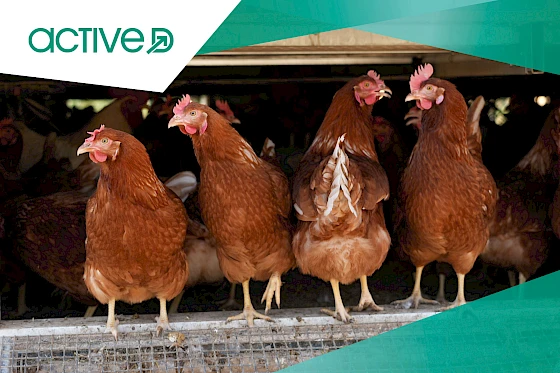
Over the past few years, the Wacholderhof in Eltville am Rhein has evolved from a traditional farm into a diversified direct-sales operation with nearly 10,000 laying hen spaces. A key factor in its success is consistently high egg quality, even from older laying hens. The farm’s goal is to achieve a laying period of about 15 months.
The problem: As the birds age and egg size increases, the stability of the eggshell in particular becomes a challenge. Cracked and broken eggs, as well as other grade-B eggs, result in immediate losses for direct-marketing operations.
To support shell quality over as long a laying period as possible, the Wacholderhof therefore tested “Active D ” under real-world conditions for about ten months. Groups of laying hens of the same age—some receiving “Active D ” and others not—were compared.
“ Active D ” was specifically mixed into the laying hens’ feed during the trial. The hens accepted the feed without any problems. No significant differences in overall animal health were observed, but the most visible effects were evident directly in the eggs.
A clear difference was particularly evident in older birds: the shell quality of the groups fed Active D remained stable for a longer period. At the same time, the farm observed fewer cracked and broken eggs, less grade-B egg production, and a tendency toward larger eggs, which is particularly important for the goal of extending the laying period, as this ensures that as many eggs as possible remain marketable until the end of the rearing period. Some flocks were not culled until 16 to 17 months of age and were still achieving a laying rate of about 70 to 75 percent at that time.
The farm also observed positive trends in egg stability during the warmer summer months. However, during extreme heat of around 40 °C, feed intake and performance declined significantly in all groups, so that no clear difference could be detected under these conditions.
The history of the Wacholderhof stretches back several centuries. As early as 1500, the site was
mentioned as a juniper pasture, from which its current name is derived. The family’s modern history began around 45 years ago, when the farm manager’s father took over the farm. The original focus was on pig breeding and rearing.
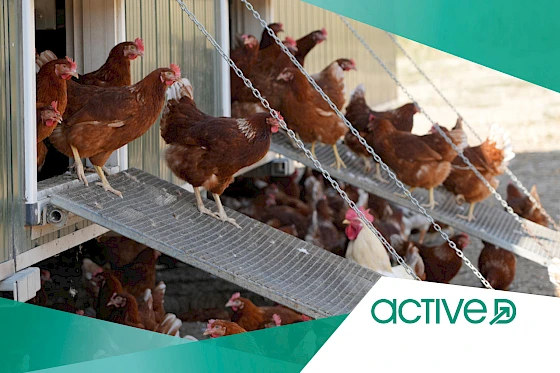
In 2016, the farm then began mobile laying hen production with 100 hens in a homemade mobile house. Laying hen production gradually developed into an important branch of the Wacholderhof’s operations. Today, six mobile housing units, with a total of just under 10,000 places for laying hens – predominantly brown Bovans laying hens – provide a home for the flock. From the farm’s perspective, the birds are particularly impressive due to their hardiness and consistent performance under free-range conditions.
At the same time, the farm has continuously expanded its direct sales. The majority of the eggs are sold through the farm’s own shop. In addition, there are regional retailers such as butchers, bakeries, farm shops and privately run REWE supermarkets. A farm café complements the offering and brings consumers directly to the farm.
The Wacholderhof now farms just under 155 hectares of agricultural land, of which around 130 hectares are arable land. The wheat and barley grown on the farm are mainly used to feed the farm’s own pigs and laying hens and are processed for this purpose at the farm’s own milling and mixing plant.
For the Wacholderhof farm, following a practical trial lasting around ten months, ‘Active D ’ is, above all, a tool for maintaining consistent eggshell quality over a long laying period.
“I would continue to use ‘Active D ’ on my farm and would also recommend it to others, as the shell quality was noticeably better throughout the trial period than in the control groups of the same age.”
Frederic Witt, owner of the Wacholderhof
| Business Segments | |
| Laying hens | Just under 10,000 spaces, six mobile housing units |
| Genetics | Predominantly brown Bovans |
| Other Animal Husbandry | Pig breeding and pig farming |
| Land area | just under 155 ha, of which approx. 130 ha is arable land |
| Feed | In-house grinding and mixing facility |
| Direct Sales | Farm store, farm café, and regional retailers |

Stevan Petrović holds a Doctor of Veterinary Medicine degree from the University of Belgrade. Since 2016, he has gained extensive experience in the animal nutrition industry, combining expertise in veterinary medicine, technical support, and product management. Since February 2026, Stevan serves as Product Manager for Active D at Phytobiotics.
Contact our experts or send us a message. We will contact you as soon as possible.