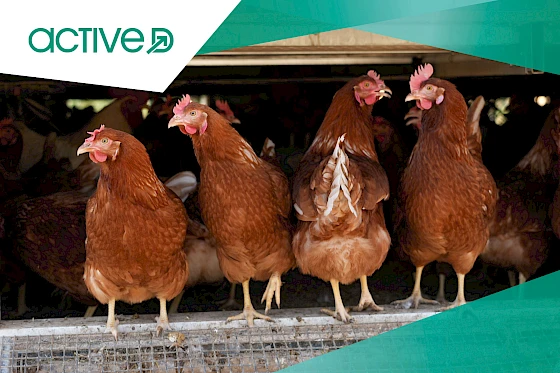
Modern poultry production adheres to exceptionally high-quality standards, regardless of whether it is an intensive care system or a free-range setup. However, free-range layers present a unique set of challenges. Without the luxury of strictly controlled environmental conditions, producers must work twice as hard to ensure the final product meets the rigorous demands of today’s consumers.
One of the most critical challenges in table egg production is maintaining optimal eggshell quality. For modern farmers, a weak eggshell is a direct threat to profitability, leading to high percentages of cracked, unsellable eggs and significant financial loss.
Beyond the economic impact, shell integrity is a crucial biosecurity barrier. A fragile shell acts as an open door for pathogens, posing a serious food safety risk that can lead to contamination and impact on human health upon consumption.
Weak Eggshells = Financial Losses (Cracked Eggs) + Biosecurity Risks (Pathogen Entry)
Eggshell quality is inherently linked to vitamin D metabolism and the bird's ability to efficiently
utilize dietary calcium. To bridge this nutritional gap, targeted supplementation is essential, especially during high-demand production phases.
Active D offers effective natural solutions for boosting vitamin D metabolism. With the activated form of vitamin D (calcitriol glycosides), it bypasses traditional metabolic pathway to maximize calcium absorption.
The theory behind Active D is strongly backed by field performance. In a recent commercial application at a layer farm in Germany. Once again, it was demonstrated its positive impact—this time within a challenging free-range layer production environment.
The study conducted at the layer farm was part of a research project together with École supérieure d'agriculture d'Angers from France. The researcher joined this project together with Phytobiotics to identify potential nutritional deficiencies, flock health, and egg production management.
During 37 weeks of the study results in Table 1. showed that Active D, by supporting vitamin D metabolism, significantly improves calcium utilization in free-range layer hens. This has led to a highly positive effect on egg quality, specifically enhancing eggshell quality through better strength and weight.
From an economic perspective, these improvements bring substantial profitability and financial gains to free-range egg production.
Table 1. Active D impact on eggshell parameters in free range laying hens, Germany 2026 (p < 0.05)
| Parameters | Control ± SD | Active D ± SD | Difference (%) | p – value |
|---|---|---|---|---|
| Eggshell Thicknes (mm) | 0.60 ± 0.03 | 0.61 ± 0.02 | 1.65 | 0.00003 |
| Eggshell Weight (g) | 6.23 ± 0.22 | 6.37 ± 0.18 | 2.22 | 0.0004 |
| Eggshell % | 10.14 ± 0.22 | 10.27 ± 0.24 | 1.27 | 0.005 |

Stevan Petrović holds a Doctor of Veterinary Medicine degree from the University of Belgrade. Since 2016, he has gained extensive experience in the animal nutrition industry, combining expertise in veterinary medicine, technical support, and product management. Since February 2026, Stevan serves as Product Manager for Active D at Phytobiotics.
Contact our experts or send us a message. We will contact you as soon as possible.