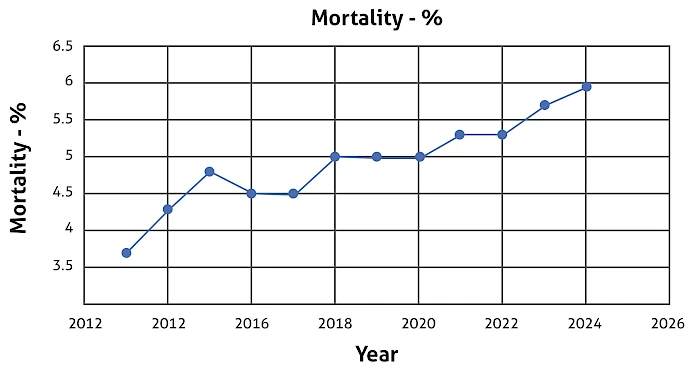
According to the National Chicken Council, U.S. broiler mortality has worsened in recent years, eroding margins and complicating welfare performance indicators (Fig. 1). Integrators and producers are increasingly asking whether plant-based feed additives can enhance performance and reduce mortality, particularly in heavy birds and during late-cycle stress periods. A new meta-analysis with Sangrovit® (Phytobiotics Futterzusatzstoffe GmbH), a preparation based on Macleaya Cordata with standardized ingredients (isoquinoline Alkaloids – IQs), offers a data-driven answer. Across multi-country trials, the addition of IQs consistently improved feed conversion by 0.04 points and cut cumulative on-farm mortality by ~25% relative - without a growth-rate penalty. These effects were most pronounced after day 40, highlighting IQs role in mitigating late-cycle mortality.
A comprehensive meta-analysis examined 36 reports encompassing 72 comparisons of control versus control plus IQs across diverse countries, production systems and years. Importantly, approximately 50% of these trials incorporated explicit challenge conditions, such as coccidiosis, clostridium perfringens infection, heat stress, high-density housing, or mycotoxin exposure. Grow-out periods extended up to 56 days, reflecting commercial broiler production cycles in the United States.
Sangrovit ® is exerting its effects through two central physiological mechanisms. First, it modulates anti-inflammatory signaling in the gut. Specifically, IQs downregulate mucosal NF-κB and TLR signaling pathways as well as associated inflammatory mediators such as TNF-α, IL-1β, and IL-6, thereby reducing this “costly” inflammatory response, making more energy available for growth and ultimately contributing to the observed improvement in feed conversion ratio (FCR).
Second, IQs support gut barrier integrity. They enhance the expression and function of tight-junction proteins, including ZO-1, occludin and claudin, while maintaining healthy villus architecture. This reduces paracellular leakage, helping to prevent enteric disturbances and contributing to lower mortality rates. Why it matters operationally: Less mucosal inflammation, a tighter barrier and moderated pathogen pressure lead to an improved FCR and fewer enteric-related losses. Operationally, these combined mechanisms result in birds experiencing less gut inflammation, stronger intestinal barriers and greater resilience against pathogen challenges.
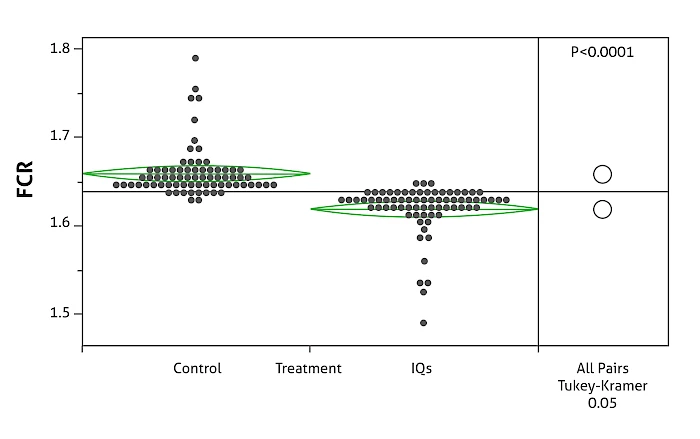
The meta-analysis demonstrated statistically significant improvements in feed efficiency and on-farm mortality. Feed conversion ratio (FCR) improved from 1.66 in the control groups to 1.62 in birds receiving IQs, corresponding to a reduction of 0.04 points (p<0.001; Fig. 2). In commercial broiler production, such differences are considered operationally relevant due to their impact on overall feed costs.
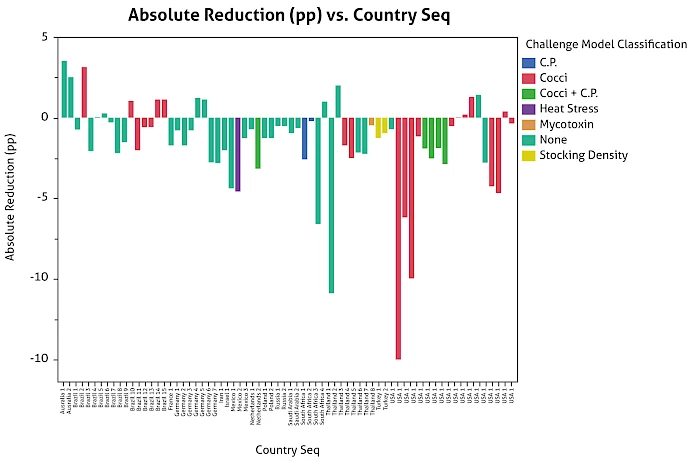
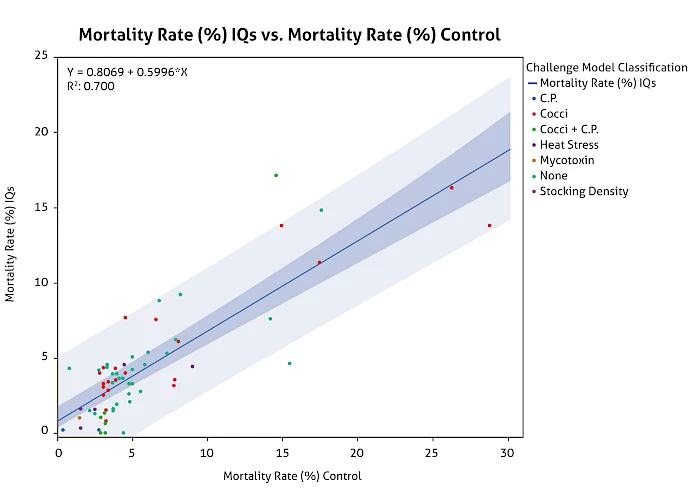
Cumulative on-farm mortality decreased from 6.1% in the control groups to 4.6% with IQs supplementation. This represents a reduction of 1.5 percentage points, equivalent to an approximate 25% relative decrease (p<0.001; Fig. 3 and 4). Average daily gain (ADG) did not differ significantly between treatments (0.062 kg/day in control versus 0.063 kg/day with IQs).
Sangrovit ® can be integrated into established coccidiosis and necrotic enteritis control programs and is compatible with vaccines, ionophores, chemical anticoccidials and shuttle or rotation programs. Its mode of action does not interfere with these tools, allowing seamless inclusion in existing disease-control strategies.
Within broader gut-health concepts, IQs can be combined with probiotics (e.g., Bacillus spp.), organic acids and essential oils without compromising growth performance. In AGP-replacement systems, they support non-antibiotic performance strategies. Improvements in feed conversion ratio (FCR) and reductions in mortality are additive to gains achieved through optimized ventilation, litter management, stocking density and water quality programs, contributing to a holistic efficiency approach. Targeted use may be prioritized in houses with elevated loss on farm rates ≥ 5–7%, in heavier or older flocks, or under known necrotic enteritis pressure. As mortality often increases after day 40, supplementation from approximately day 35 through harvest may help address losses during the critical late phase. Monitoring should include weekly tracking of mortality, clear differentiation between culls and dead-on-arrival birds and maintenance of coccidiosis cycling diagnostics (lesion scores/oocyst counts) to verify complementarity and timing.
Across geographies, challenge models and production systems, Sangrovit® improves feed efficiency and reduces on-farm mortality. Its mode of action—mitigating gut inflammation and supporting intestinal barrier function—makes it compatible with cocci vaccines, ionophores/chemicals, probiotics, organic acids and essential-oil programs.

Verena Determann holds a Bachelor of Science in Agricultural Economics from the University of Applied Sciences in Bingen and subsequently deepened her expertise through a Master’s degree in Livestock Sciences at Justus Liebig University Giessen. Nowadays, Verena serves as the Product Manager for Sangrovit® at Phytobiotics.
Contact our experts or send us a message. We will contact you as soon as possible.