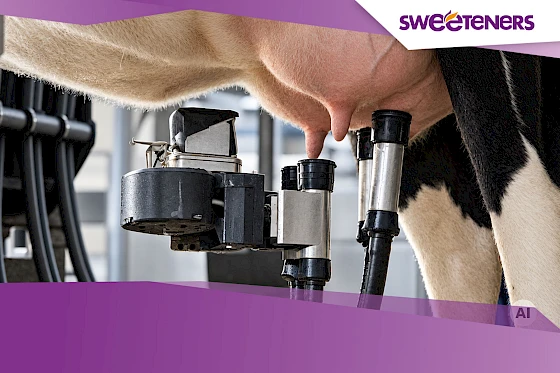
Automatic milking systems rely on regular and voluntary cow traffic. In this context, the concentrate feed offered in the milking robot is more than a source of nutrients: it also contributes to the motivation of cows to enter the milking unit. Its sensory profile, including taste, odour, texture and overall palatability, may therefore influence concentrate acceptance and contribute to the reward value of the concentrate offered in the AMS.
Robot concentrates are generally formulated with palatability and feeding behaviour in mind, as they are intended to support voluntary robot visits. Feed attractiveness is therefore already an important consideration in AMS feeding strategies. At the same time, the sensory profile of concentrate feed is influenced by raw material composition, processing, pellet quality, mineral supplementation and natural batch-to-batch variation. Even when the feed is already designed to be attractive, sensory solutions can provide an additional way to fine-tune its taste and odour profile.
PhytoSweet is based on finely ground stevia leaves. As a plant-based material, it combines the natural sweetness of Stevia rebaudiana with a mild herbal, hay-like odour. Rather than simply adding sweetness, PhytoSweet is intended to support a balanced and recognisable sensory profile in concentrate feeds. Its purpose is to enhance feed attractiveness and contribute to the reward value of the concentrate offered in the milking robot under practical farm conditions.
This can be particularly relevant in automatic milking systems, where feed attractiveness, feeding behaviour and voluntary robot attendance are closely connected. By supporting the palatability of the concentrate offered in the robot, PhytoSweet may contribute to voluntary cow traffic as part of a well-managed AMS feeding strategy.
To evaluate the practical relevance of PhytoSweet as a plant-based attractant in concentrate feed for automatic milking systems, an on-farm evaluation was conducted on four commercial dairy farms. In total, 314 lactating dairy cows were included. The participating herds had an average annual milk yield of approximately 9,847 kg per cow, representing conditions typical of high-performing commercial dairy herds.
PhytoSweet, a finely ground stevia leaf material, was incorporated into the concentrate feed offered in the automatic milking system at an inclusion rate of 750 to 1,000 g per tonne of concentrate feed, corresponding to 750 to 1,000 mg per kg of concentrate. The exact inclusion rate was determined at farm level according to the respective concentrate feeding programme.
Robot visit behaviour was evaluated by comparing farm-recorded AMS data from the baseline and PhytoSweet periods. Following the introduction of PhytoSweet, a seven-day adaptation period was applied to allow the cows to adjust to the modified sensory profile of the concentrate. Data from this adaptation period were excluded from the final evaluation.
The primary outcome parameter was the average number of robot visits per cow per day. Robot visits were assessed using farm-recorded AMS data. Where available, additional AMS-related parameters, including successful milkings, refused visits, concentrate intake, milk yield and the number of cows requiring fetching, were reviewed to support the interpretation of the results.
As the evaluation was conducted under commercial farm conditions, the results should be interpreted as practical field observations. Farm-specific factors such as cow traffic design, robot settings, concentrate allocation, partial mixed ration composition, stage of lactation, parity and animal health status may influence robot attendance. These factors were therefore recognised as relevant background factors when interpreting changes in AMS visit behaviour.
Robot visit frequency during the baseline and PhytoSweet periods was compared using a paired t-test. Differences were considered statistically significant at p < 0.05.
The inclusion of PhytoSweet in the AMS concentrate feed was associated with a statistically significant increase in average robot visits. Across the four farms, the average number of robot visits increased from 2.60 to 2.95 visits per cow per day (Figure 1).
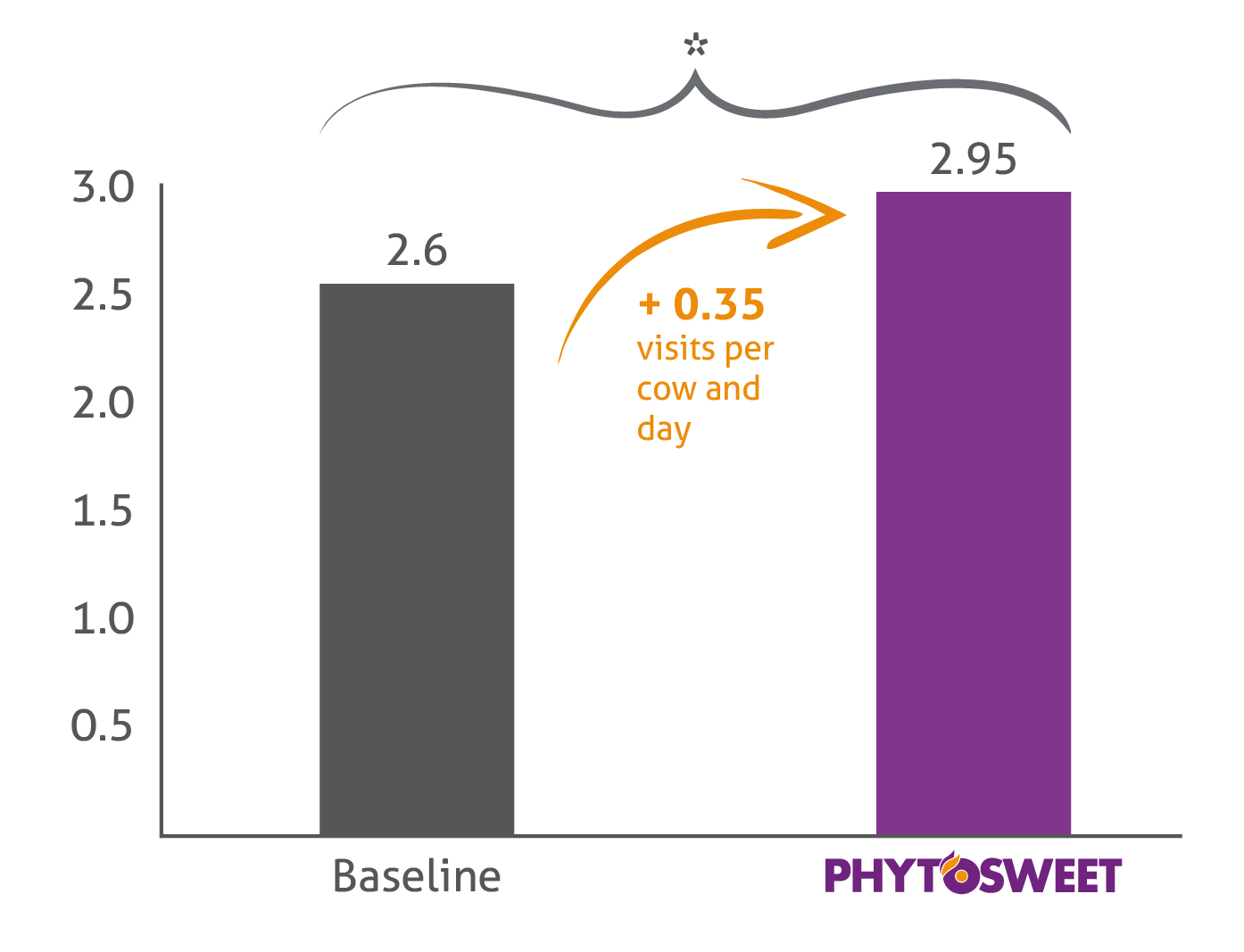
Figure 1. Average robot visits per cow per day during the baseline period (without PhytoSweet) and the PhytoSweet period across four commercial dairy farms (314 lactating cows in total). The observed mean increase was +0.35 visits per cow per day. Farm-level baseline and PhytoSweet values were compared using a paired t-test (n = 4 farms). An asterisk indicates statistical significance (p < 0.05).
This corresponds to an observed increase of 0.35 additional robot visits per cow per day, or approximately 13.5% compared with baseline. The difference was statistically significant based on the paired t-test (p < 0.05).
From a practical perspective, this is a relevant observation. In automatic milking systems, regular robot attendance is an important factor for maintaining consistent milking routines. A higher visit frequency may support more stable cow traffic to the robot and could contribute to improved milking frequency and more efficient use of the AMS, although its practical relevance depends on the proportion of successful milkings and refused visits.
The results indicate that PhytoSweet may be considered a plant-based attractant for AMS concentrate feed. By supporting the sensory profile and attractiveness of the concentrate, PhytoSweet may help encourage cows to visit the milking robot more frequently.
Its finely ground stevia leaf composition, mild plant character and pleasant hay-like note make PhytoSweet particularly suitable for ruminant feed applications and plant-based feeding concepts. In AMS systems, this sensory profile may support concentrate acceptance at the robot and contribute to voluntary cow traffic management.
Under practical dairy farm conditions, the inclusion of PhytoSweet in AMS concentrate feed was associated with a statistically significant increase in robot visits. Cows receiving PhytoSweet-containing concentrate showed, on average, 0.35 additional visits per cow per day.
These findings suggest that PhytoSweet may be a practical tool to support robot attendance in automatic milking systems. By modifying the sensory profile of the concentrate feed, PhytoSweet may help increase its attractiveness and encourage voluntary robot attendance as part of a well-managed AMS feeding strategy.

Dr. Anne Winkler: After obtaining a Diploma in Agricultural Science, Anne pursued a Master's degree in Agricultural Science and Environmental Protection at the University of Applied Sciences in Bingen. In 2018, she earned a PhD in Agricultural Science from Martin-Luther-University Halle-Wittenberg. With her strong scientific background, Dr. Anne Winkler now brings her expertise to her role as the Global Product Manager for Flavours & Sweeteners at Phytobiotics.
Contact our experts or send us a message. We will contact you as soon as possible.